What are Advanced Placement courses? AP courses are first-year university courses overseen by the US-based College Board. AP gives high school students exposure to university-level curriculum while studying subject matter that they are deeply curious about. AP is best suited for students with strong independent learning skills and a willingness to meet the demands of an increased workload.
Students can potentially earn university credit by passing exams in May. Exams are marked by the College Board and receive a score of 1–5, with 3+ is considered a passing grade. Most universities require a 4 or 5 on the exam to be accepted as a replacement for a first-year course.
Why “without risk”? AP has no bearing on admission to Canadian universities, which focus on a student’s six Grade 12 university-level (4U/M) courses. That makes AP at Hudson pure enrichment: students who take it on gain university-level experience and the chance to earn credit, and students who don’t are at no disadvantage in their application.
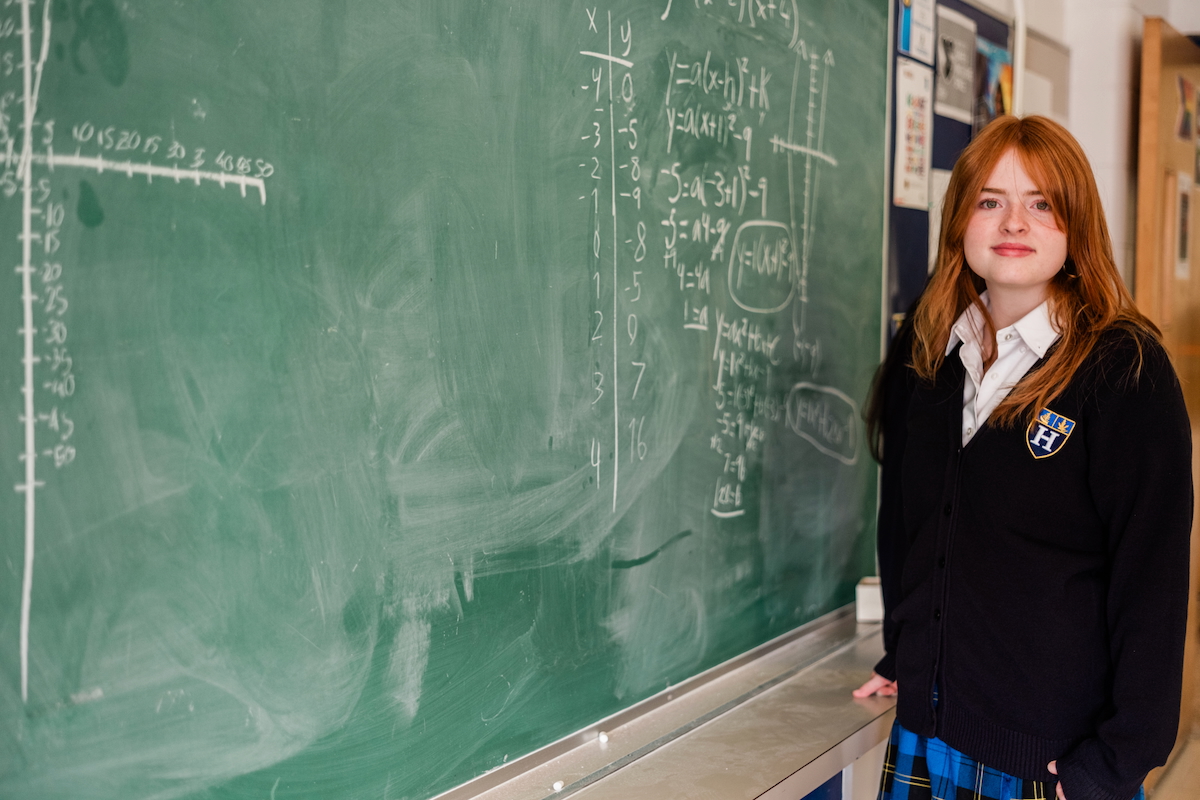
AP Calculus AB will be taught by Dylan Mimna, our Head of Math. Calculus is the mathematics of change, and the foundation of physics, engineering, economics, computer science and medicine. The course is designed to stretch students beyond the familiar and build the mathematical maturity universities expect. What students take away is more lasting than the credential: the ability to sit with a hard problem, reason through it carefully and arrive at a solution with confidence. AP Calculus is the final step in our accelerated math pathway. Students with exceptional results in Grade 9 and 10 math, and a recommendation from their teacher, can complete the Grade 11 and 12 Ontario math sequence a year early, which opens up Grade 12 for AP Calculus. Our current Grade 12 students are the first cohort to have been offered this pathway, and about one in six of them will take AP Calculus AB this year.
AP Psychology will be taught by Brooke Cafaro, our Head of English. This stand-alone elective is for ambitious Grade 11 students who want to go deeper into psychology than Ontario’s introductory Anthropology, Sociology and Psychology course (HSP3U) allows. Students ask not just what people do but why, and learn to examine evidence, challenge assumptions and build an argument. Because the course involves intensive reading and writing, students apply to enrol with a short personal statement and a recommendation from an English teacher. No acceleration is required, and the course doesn’t affect the rest of a student’s timetable.
Hudson is a registered AP testing centre. Upper School students in any grade can self-study for an AP exam of their choosing and write it here at school. This past May, four then-Grade 10 students did exactly that, successfully writing exams in AP French, AP Macroeconomics and AP Environmental Science. We especially recommend this route for motivated Grade 9 and 10 students who are already making the most of their daily skills period in the Fall and Winter semesters. The Ontario curriculum in these years is deliberately broad, and preparing for an AP exam is a great way to take a one-off dive deep into a subject. By Grade 11, Ontario course options expand and specialize, and students can choose electives that more closely match their strengths and interests.
We plan to add an AP lab science (Biology, Chemistry or Physics). Working with our current Grade 9 and 10 cohorts, we’ll offer STEM-strong students the chance to accelerate a science course, much as we’ve done in math. Which science we run will depend on each cohort’s interests: some years that may be Physics, other years Biology. We would rather shape AP around the students in front of us than lock in a fixed menu.
Lisa Streff, our Head of Guidance, is happy to talk with families about whether AP is a good fit for their child. You can also ask about AP and our accelerated pathways on a tour or at an Open House.